

Who Learns the Job If the Agent Does It?

Christian Timotti
Supply Chain across the US, Brazil and Latin America · October 22, 2026
More than half of supply chain leaders expect agentic AI to cut entry-level hiring. Almost nine in ten say they will need a new way to build talent. Very few are asking what the old way actually was.
Picture a junior supply planner's day, the way it ran in most companies until recently, and still does in many.
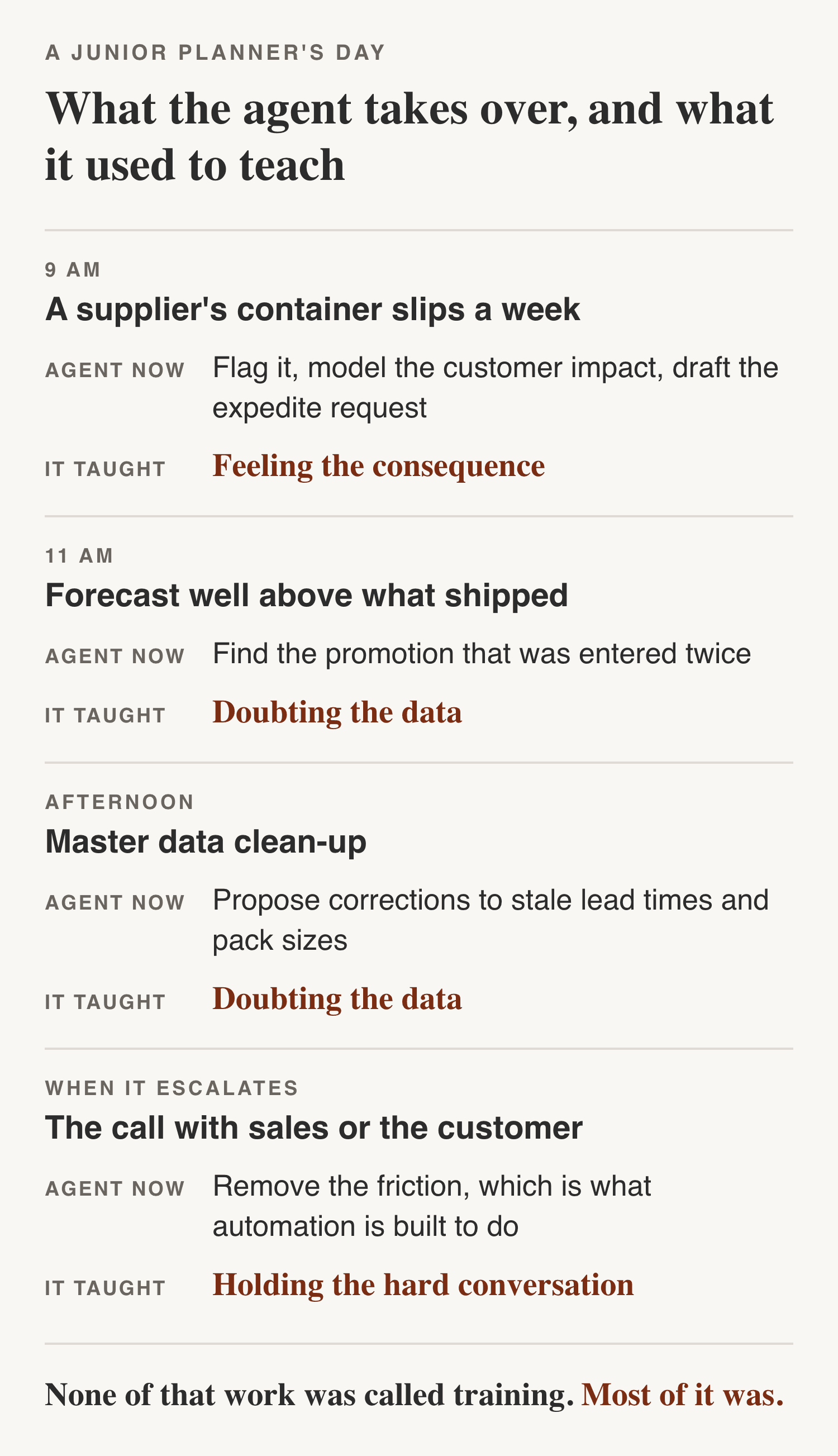
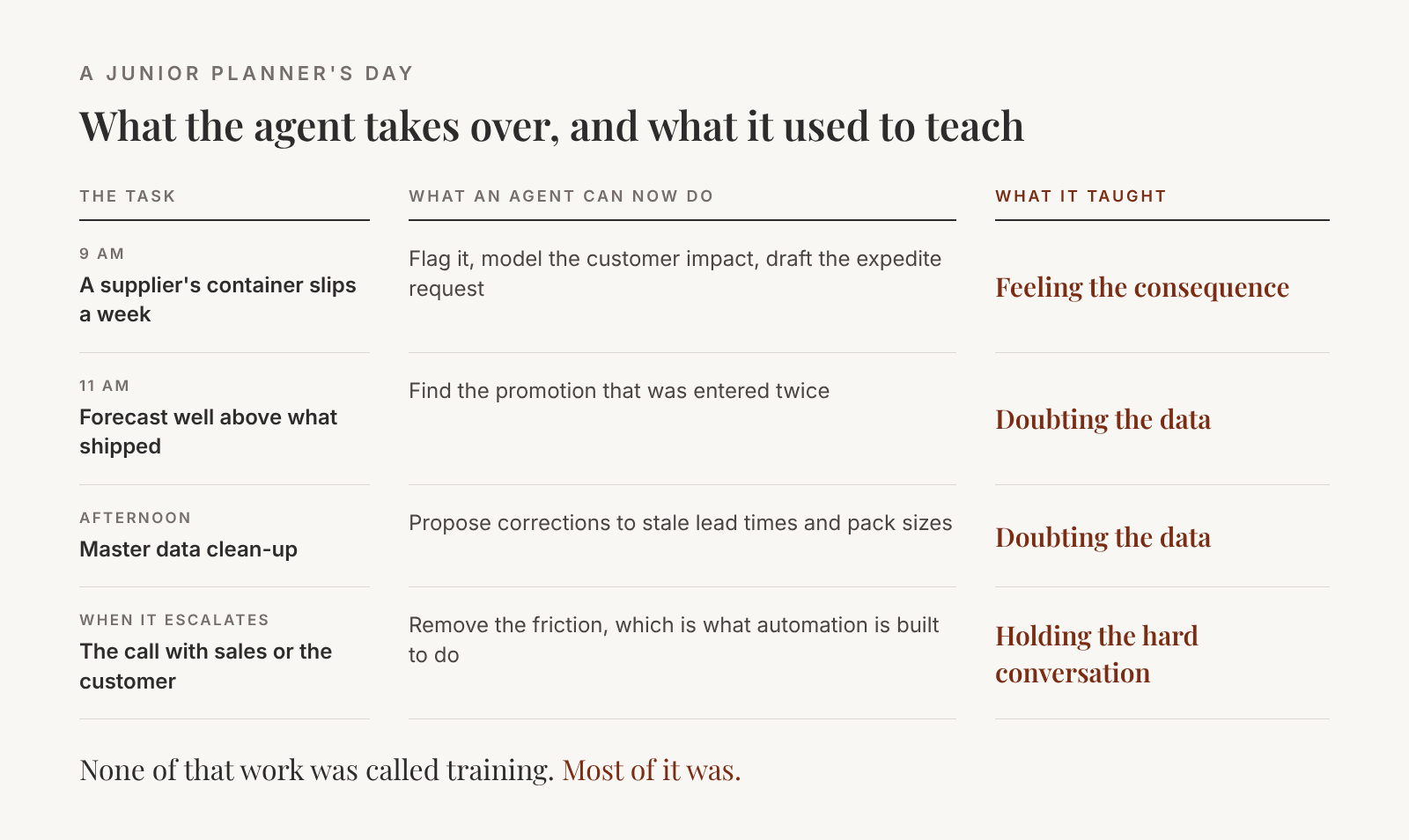
At 9 AM, a supplier says a container will be a week late. Someone has to work out which customers the delay will hit, call the account manager, and decide whether to air-freight part of it. The junior does the legwork. The decision goes up a level, but the junior hears the reasoning.
At 11 AM, the forecast for a top-ten SKU turns out well above what actually shipped, and someone has to find out why. Often it is a promotion entered twice. The junior finds it, because the junior is the one who actually opens the data.
The afternoon goes to master data. Lead times nobody has touched since the supplier changed. Pack sizes that make the reorder logic ask for fractions of a pallet. Dull work. Everyone avoids it.
An agent can now do a good share of that day. It can flag the late container, model the customer impact, draft the expedite request, find the double-loaded promotion, and propose master data corrections for approval.
None of that work was called training. Most of it was.
The number everyone quotes, and the one next to it
In February, Gartner published a survey of 509 supply chain leaders. 55% expect agentic AI to reduce the need to hire for entry-level positions. 51% expect it to lead to overall workforce reductions.
Those are the figures most people have commented on. The one beside them got far less attention: 86% agree that adopting agentic AI will require new processes for developing their future talent pipeline.
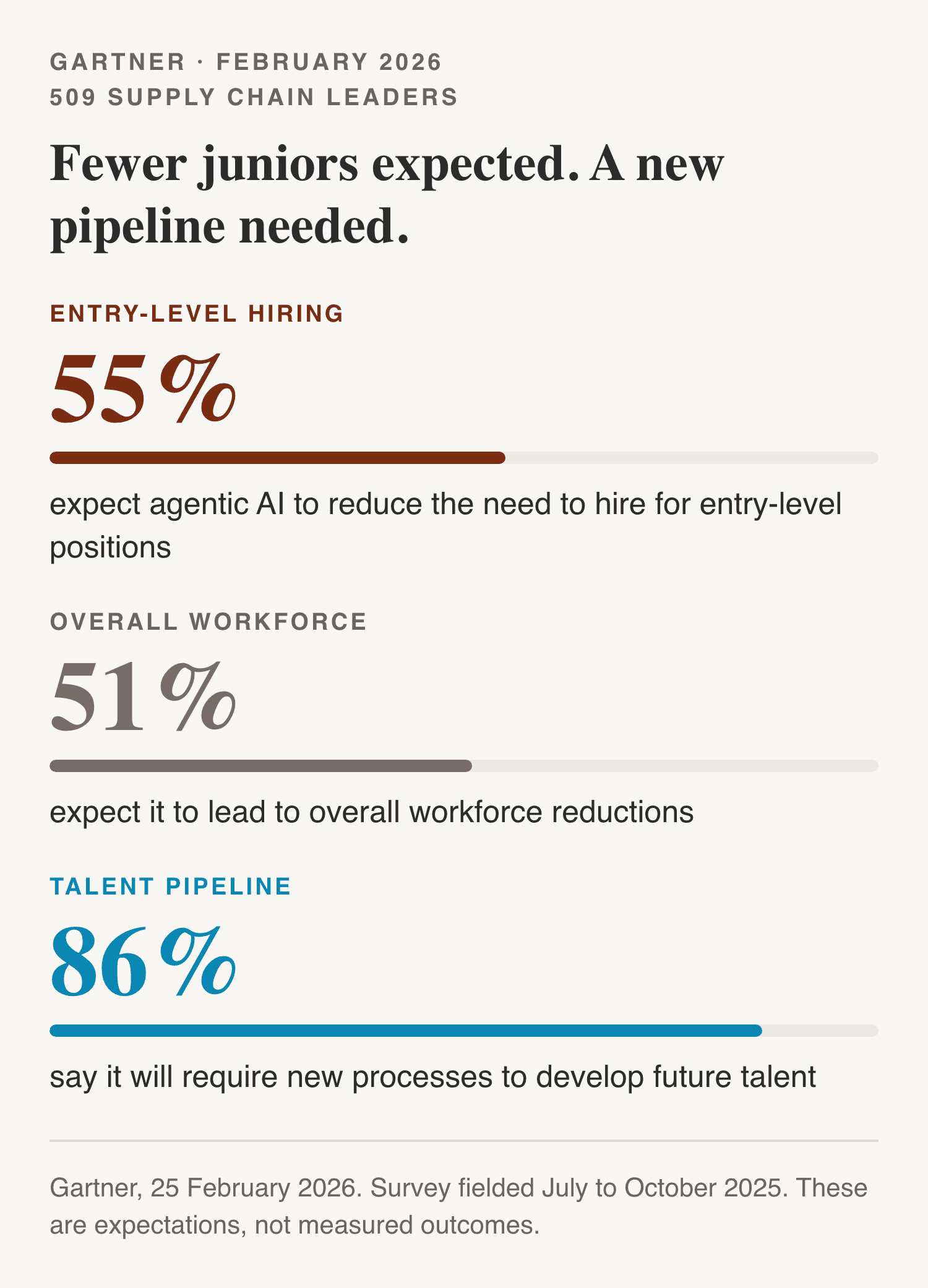
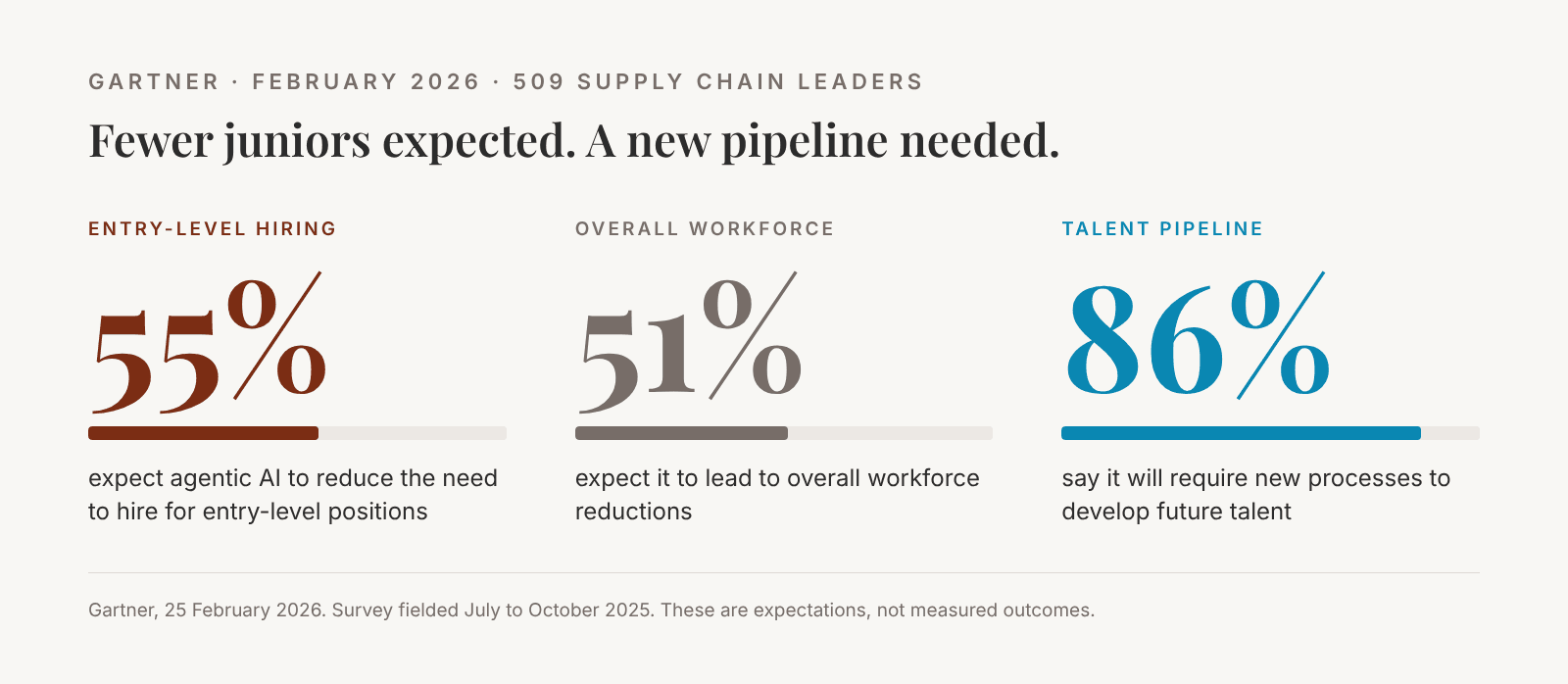
Read the three together. Most leaders expect to hire fewer juniors. Nearly all of them expect to need a different way of growing the people who will run the function later. The release does not describe anyone who has built that different way yet, and I have not met many who have tried.
Gartner's Marco Sandrone put it carefully: "Entry-level roles as understood today may fade in importance, but supply chains will still need emerging talent that is highly adaptive and innovative." Gartner also found that its higher-performing respondents were putting the redesign of talent strategy ahead of headcount reduction.
One caveat. These are expectations, collected between July and October 2025. Nobody has measured the outcome yet.
The hiring that does not happen
There is early evidence that the outcome is already arriving, quietly.
Erik Brynjolfsson's team at the Stanford Digital Economy Lab tracks ADP payroll data covering millions of US workers. In the August revision of their paper, employment for people aged 22 to 25 in the occupations most exposed to AI sits about 19% below where it would be if it had kept pace with less exposed peers. Experienced workers in the same occupations show no comparable gap.
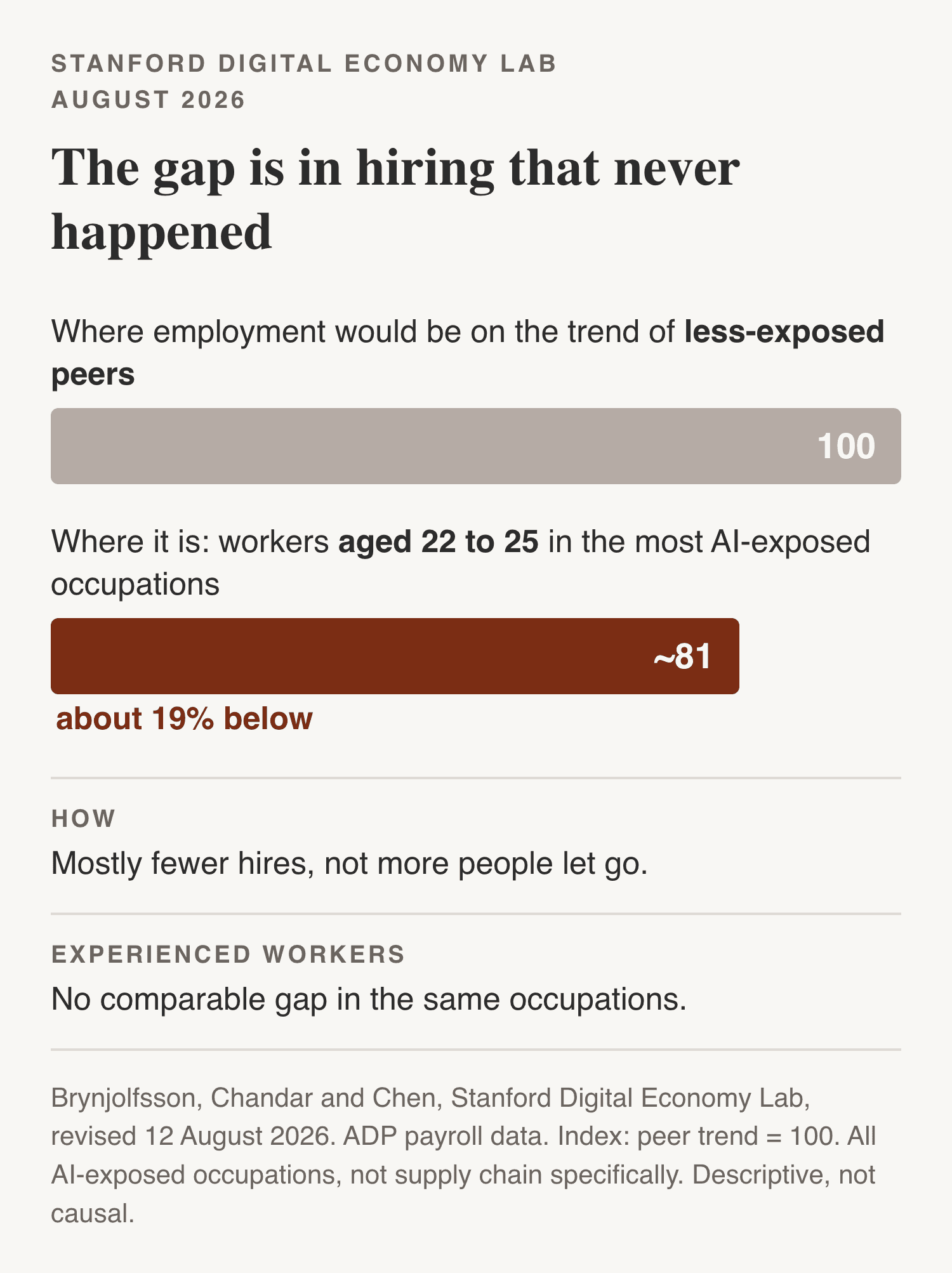
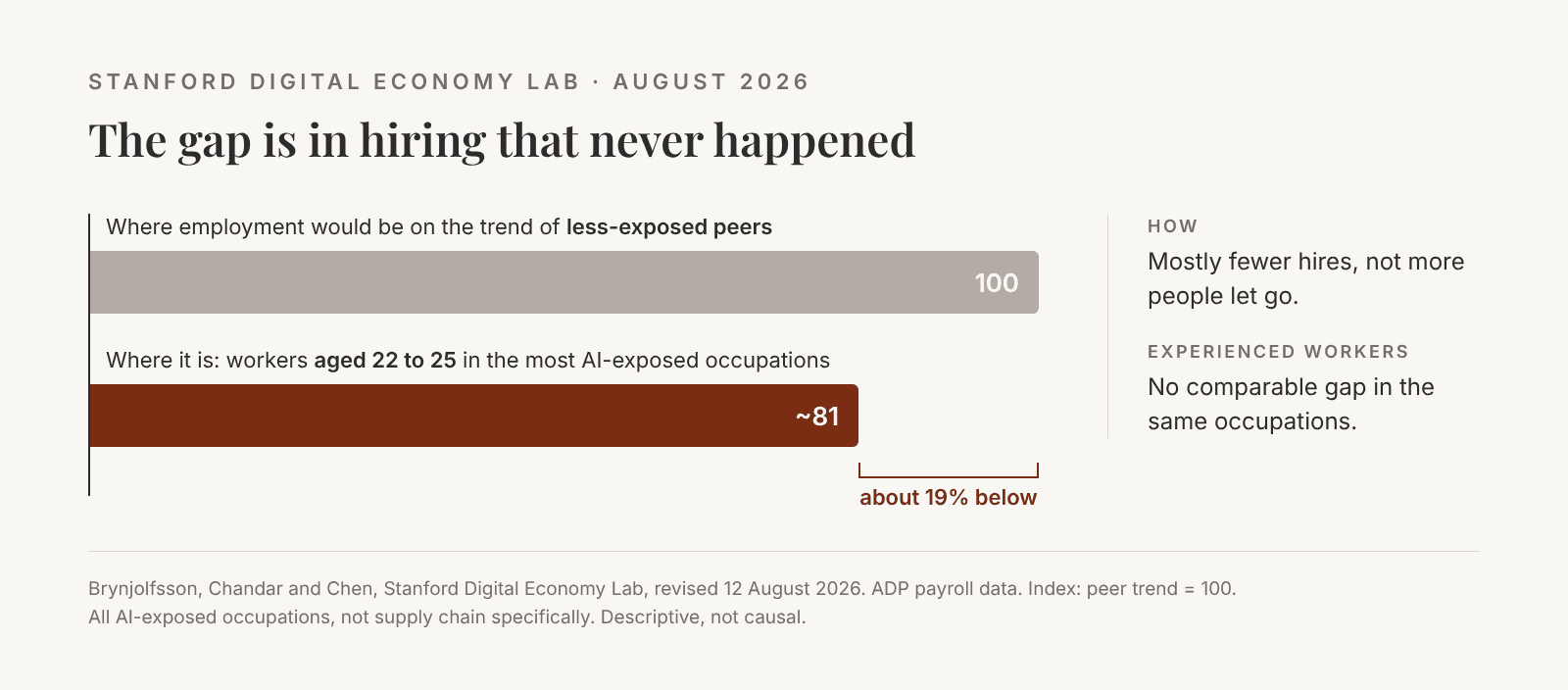
For supply chain leaders, how this is happening matters more than the size of it. The gap comes mostly from reduced hiring, not from people being let go.
That is why it is so hard to see. A layoff shows up in the headcount report and sometimes in the press. A requisition that was never opened shows up nowhere. Nobody presents it at the quarterly business review.
Two caveats, both of which the authors make themselves. The findings are descriptive, not causal. And they cover AI-exposed occupations across the whole economy, not supply chain in particular. I am using them as a signal of direction, not as a supply chain statistic.
What the entry-level job taught
When I think about what turned good planners into good supply chain leaders, it was rarely a training course. It was what the routine work forced on them.
- Doubting the data — Anyone who has spent a month reconciling system lead times against what suppliers actually deliver learns, permanently, that the ERP is a claim, not a fact. That instinct is what makes a senior leader ask the right question when a dashboard looks too clean.
- Feeling the consequence — A junior who chased a short shipment for a key account, then sat on the call when the customer escalated, understands safety stock differently from someone who only learned the formula. Being wrong stops being abstract.
- Holding the hard conversation — Telling a sales director their forecast is not credible, or telling a supplier their confirmed date is not reliable, is a skill. It is learned in small doses, on small stakes, years before anyone trusts you with a big one.
My first job was as a logistics analyst in a distribution center. I monitored inventory accuracy by product class, tracked service levels, and sat between sales and manufacturing whenever their numbers disagreed. Cycle counts, accuracy gaps, orders that did not match the stock: I saw all of it long before anyone trusted me to fix any of it. That was the training. Nobody called it that.
An agent can do the checking. It does not hand the instinct to the person sitting next to it. And it removes most of the consequence and most of the conversation, because the escalation call and the awkward meeting are exactly the friction automation is built to take out.
The bench you will not have
The cost of this lands much later than the saving.
Your senior bench is a lagging indicator of your junior hiring. The S&OP director you will need in ten years should be, today, in their second or third year in demand or supply planning, procurement, or logistics. If you did not hire that person, or hired them into a role where the agent does the learning, they will not be ready when you need them.
You will notice in about a decade. By then, the fix is expensive. You buy the judgment from outside, at a premium, from whoever did build it.
What redesign looks like
The 86% are right that the way talent is grown has to change. In practice, I would start with five moves, and none of them requires a new system.
- Make juniors the owners of the agent's exceptions — When an agent handles the routine, the exception queue is where the learning lives. Give it to the junior, with a senior one step behind, instead of routing it to the most experienced planner because that is faster.
- Run a weekly "why was the agent wrong" review, and have the junior present it — Explaining a model's miss to a room is the modern version of explaining your own forecast miss. It builds the same muscle: doubting the output, finding the cause, saying it out loud.
- Give one junior a seat in the demand review from the first month — Not to observe. Give them one question they are responsible for answering every cycle.
- Judge rotations on decisions explained, not tickets closed — If the agent closes the tickets, a ticket count measures the agent. Ask the junior to walk through three decisions they influenced and why.
- Keep some manual cycles on purpose — Since 2013, the FAA has encouraged airlines to have pilots fly by hand when appropriate, because constant reliance on autoflight erodes the skill to recover when it fails. A planning team can do the same: one category or one month a quarter without the agent, compared against what the agent would have done. It costs a little efficiency and tells you whether anyone still understands the logic.
Here is what the starting point can look like. At a manufacturer I worked with recently, the supply planning analyst built the weekly production orders by hand: Excel files with the volumes, the capacity of each line, and daily adjustments on top. Hours of data handling every week, and very little time left, for him or his supervisor, to look at alternatives or ask why the plan kept moving.
We mapped the process and put a simple agent on the reconciliation between planning and production, matching the numbers and flagging the adjustments. The manual work dropped. The time went back to the planning team, who used it to find further quick wins in the plan and in the hand-offs with sales, customer service and logistics. The agent took the arithmetic. The people kept the judgment.
The case against my argument
There is a fair counterargument. A junior with a good agent beside them might learn faster than any junior before them. They can ask it why a forecast moved, test a scenario in minutes instead of days, and see more situations in a year than most of us saw in three.
The Stanford data partly supports this. Where AI mainly complements what people do rather than substituting for it, employment is flat or rising, especially for experienced workers.
I agree, and that is the point. Whether the agent becomes a tutor or a replacement is not decided by the technology. It is decided by whoever writes the job description and designs the workflow. Most companies are making that choice by default, one budget cycle at a time, without noticing they are making it.
Sources
Gartner, "Gartner Survey Shows 55% of Supply Chain Leaders Expect Agentic AI to Reduce Entry-Level Hiring Needs", 25 February 2026. Survey of 509 supply chain leaders, fielded July to October 2025.
Brynjolfsson, E., Chandar, B. and Chen, R., "Canaries in the Coal Mine? Six Facts about the Recent Employment Effects of Artificial Intelligence", Stanford Digital Economy Lab working paper, revised 12 August 2026. ADP payroll data.
Federal Aviation Administration, Safety Alert for Operators SAFO 13002, "Manual Flight Operations", 4 January 2013.
Reflection
The agent will do that junior planner's day. That part is settled. What is not settled is whether anyone learns from it.
What did your first supply chain job teach you that no system would have?
Before you close this
Who came to mind while you were reading?
If someone you work with would recognize themselves in one of these signals — or would sleep better knowing what to look for — send it to them. It is a shorter conversation than the one that happens two years from now.
About the Author
Christian Timotti
Founder of Carpe Omnia. 20+ years of executive experience in supply chain, operations, and leadership development.